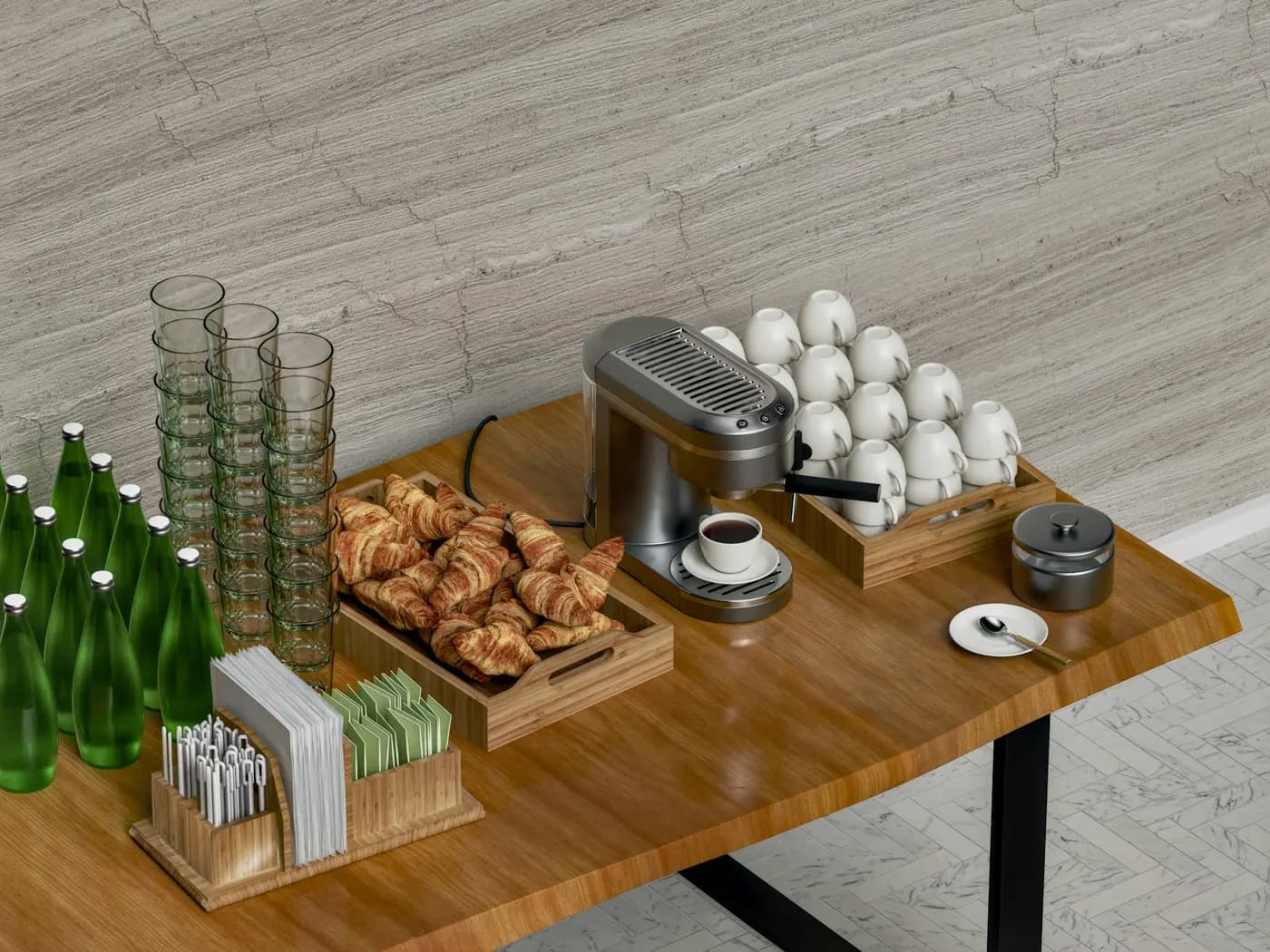
Pantry
The highest-frequency category in coworking, and the most visible to members when it fails.
- Tea, coffee and beverages
- Disposables and crockery
- Water and dispensers
- Snacks and refreshments
Industries
Scale procurement across centers without losing operational control, and without a new center meaning a new set of suppliers.

Who this is for

Every center
buys the same things, weekly
The industry problem
A member never sees the contract. They see whether there is coffee at four in the afternoon and whether the meeting room was cleaned. That makes recurring procurement an operational commitment rather than an administrative one, and it is usually being run out of a center manager's own initiative.
Procurement fragmentation
Each new location repeats the whole sequence rather than joining an existing one.
Happens at: New location
Happens at: New location.What it looks like: Suppliers found locally, under deadline
Left holding it
Center manager
Happens at: New location
Happens at: New location.What it looks like: Built from habit, not from a catalogue
Left holding it
Center manager
Happens at: New location
Happens at: New location.What it looks like: Ad hoc, triggered by running out
Left holding it
Center manager
Happens at: New location
Happens at: New location.What it looks like: Local rate, no reference to other centers
Left holding it
Center manager
Happens at: Central
Happens at: Central.What it looks like: Per center, per vendor, per month
Left holding it
Finance
Happens at: Central
Happens at: Central.What it looks like: Not comparable between centers
Left holding it
You
Read the last column downwards.
The problem does not only get worse.
It gets wider, until it reaches you.
What changes with Nxtby
Standardizing what a center stocks is not a restriction on the center. It is what lets a center open with procurement already solved.
How it runs today
With Nxtby
Each center finds its own suppliers
Approved suppliers, ready before opening
Stock list grows from local habit
One catalogue, adjusted per center
Reordering triggered by running out
Recurring orders on a schedule
Rates differ center to center
One contracted rate across centers
Cost per center not comparable
Cost per center on the same basis
A new center inherits procurement instead of building it.
From the site that raises it to the record that comes back. Everything after the contract is settled before the order is placed.
Step 1: Site requirement
A site raises what it needs, in the catalogue's words rather than its own.
Step 2: Contract
Commercial terms, items and suppliers agreed once, before the first order.
Step 3: Agreed rate
The contracted rate applies at every location, so price is not renegotiated per order.
Step 4: Governed catalogue
Each location orders from an approved list set up for that location.
Step 5: Approval
Requests route to the approver your own rules name, by role and value.
Step 6: Order
Approved requests become orders at the contracted rate.
Step 7: Invoice
Consolidated GST-compliant invoicing, traceable to each order and location.
Step 8: Visibility
Spend by location and category, visible as it happens.
See what one contracted position would look like for your centers.
Categories
Three recurring categories, run under one contract with one rate and one approved supplier list. Each is set up per location, so what a site can order is what that site actually needs.
The highest-frequency category in coworking, and the most visible to members when it fails.
Daily consumption across desks, meeting rooms and washrooms, held to one specification.

Printing, paper and desk supplies, including what members are given as part of the plan.
Procurement workflow
The same six steps every time, for every site and every category. Select a step to see what it looks like in coworking operators.
Step 1 of 6
Request
A site team raises what it needs against the catalogue and contract already agreed for that location.
In coworking operators
A center manager raises the week's pantry and housekeeping top-up from the center's own catalogue.
Multi-location control
Each center runs its own catalogue, approver and delivery schedule under one operator contract.
Locations
Sample view| Center | Catalogue | Approver | Recurring orders | Spend to date |
|---|---|---|---|---|
| Indiranagar | Pantry, Housekeeping, Office | Center manager | Weekly | Rs 1.7L |
| Koramangala | Pantry, Housekeeping, Office | Center manager | Weekly | Rs 2.1L |
| Whitefield | Pantry, Housekeeping | Center manager | Fortnightly | Rs 1.2L |
| Hyderabad, HITEC | Pantry, Housekeeping, Office | Regional manager | Weekly | Rs 1.9L |
Supplier management
The operator decides who supplies a category. A center draws on that list rather than rebuilding it in a new neighbourhood.
Approvals & governance
Coworking cannot run on a two-day approval cycle for a case of coffee. The rules are set so the routine never waits and the unusual always stops.
When this happens
Who approves
What happens
Scheduled weekly replenishment
Center manager
Clears immediately. This is the majority of orders.
Above the center's value limit
Regional manager
Held for approval and visible to the center while it waits.
Off-catalogue request
Operations
Recorded as an exception rather than absorbed silently.
New center setup
Operations
Catalogue and schedule assigned from the operator template.
Nxtby does not impose an approval structure. These are your own limits and your own approvers, applied consistently to every request rather than to the ones somebody remembered to route.
Spend visibility
Two centers of the same size should consume roughly the same. Knowing when they do not is the point of measuring it at all.
SPEND BY CATEGORY, LAST 30 DAYS
Purchase orders
A purchase order carries the site that raised it, the rule it met and the person who approved it. That record is what makes a spend review a reading exercise rather than an investigation.
Purchase orders
Sample viewPO-4821Indiranagar
Pantry, scheduled replenishment
PO-4822Koramangala
Pantry, above site limit
PO-4823Whitefield
Pantry, order placed
Approval trail, PO-4822
Use cases
Common scenarios in coworking operators, and what changes structurally in each. These are illustrative situations rather than named client engagements.
Capabilities
Everything on this list is shown somewhere on this page. If it is not demonstrated above, it is not claimed here.
Answers
The questions a procurement, finance or operations team asks first, answered directly.
Coworking procurement is the buying that keeps a center running for its members: pantry stock, housekeeping consumables, office supplies and facility items. It repeats every week at every center, and member experience depends on it not running out.
Nxtby puts every center on one common catalog at contracted rates, sets up recurring replenishment for the items that move weekly, and gives the operator one view of spend by center. Center managers keep ordering what their members need; they stop negotiating it.
A new center is added as a location under the existing contract and inherits the catalog, rates and approved suppliers on day one, so it does not have to build a supplier list before it can open.
Rates and approved items are agreed once for the whole network. Each center orders against that agreement, larger or off-catalog requests route for approval, and the invoices reconcile to the contracted rate rather than to whatever a local supplier quoted.
Pantry, housekeeping, and office and stationery are the three most coworking operators start with, because they are consumed by members every day at every center.
Nxtby is a contract-led business procurement partner for enterprises in India that buy the same operational categories repeatedly across several locations. Rate contracts, approved catalogues and service levels are agreed before the first order, your teams raise requests against them, Nxtby runs sourcing and supply, and finance gets consolidated GST-compliant invoicing with a record of every order behind it.
The practical objections that come up when coworking operators move procurement onto one contract.
Yes. Catalogues are set per center, so a location with a large event space and one without do not carry the same list. Center managers raise their own orders; what they are not doing any more is appointing suppliers and agreeing rates.
A category can run on a schedule sized to that center's actual consumption rather than being triggered by someone noticing an empty shelf, and the schedule is adjusted as usage data builds up.
It is set up as a new location under the existing contract and draws on the same approved suppliers and contracted rates. There is no separate local negotiation for that center.
Yes, and that is the practical reason to standardize the catalogue. When every center orders the same items at the same contracted rate, a difference between two centers is a difference in consumption rather than in price.
No software is rolled out to center teams and the approval structure stays the one you already use. Routine replenishment inside the agreed catalogue and value clears without waiting.
Orders from every center consolidate into GST-compliant invoicing instead of arriving as one bill per vendor per center, with each line traceable to the center that raised it.
Next step
Tell us how many centers you run and how replenishment is handled today. We will show you what the same catalogue and the same rate across all of them would look like.
What happens next
You tell us how it runs today
How many centers you operate, which categories are bought repeatedly at each one, and how a request reaches a supplier today.
We come back with the picture
What one contracted position across those categories would look like: the catalogue, the approval limits and where the ordering would stay local.
You decide what, if anything, moves
Most operations start with a single category at a handful of sites. Nothing is committed by having the conversation.
Further reading
Articles from the Nxtby blog that bear on procurement for coworking operators.


Related industries
Related service
Laptops for member teams and project desks. Corporate laptop rental is a separate service, currently focused on Bangalore.

Standardize procurement across buildings